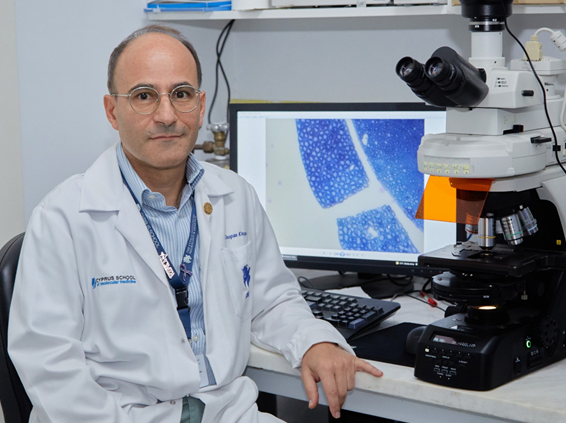
Current Position
Senior Consultant Neurologist
Head of Neuroscience Department
Director of the Neuropathology Lab
Professor, School of the Cyprus Institute of Neurology and Genetics
Coordinator, Neuroscience MSc/PhD Graduate Program
Coordinator, Center for Neuromuscular Disorders
The Cyprus Institute of Neurology and Genetics
Education
- 1987-1993 Medical Studies, University of Würzburg Medical School, Germany
- 29/10/1993 Medical Degree (grade: “very good”), University of Würzburg Medical School, Germany
- 1991-1994 Doctoral Thesis Project in the Psychiatry - Laboratory of Clinical Neurochemistry, University of Würzburg, Germany
- 18/08/1994 Doctor of Medicine Title Award (grade: “magna cum laude”), Medical Faculty of the University of Würzburg
Research Interests
The main contribution of Prof. Kleopa’s research has been the elucidation of the mechanisms causing various neurological disorders using novel experimental models, with main focus on inherited neuropathies and leukodystrophy. Furthermore, he has pioneered world-wide in the last several years cell-targeted gene therapy approaches to treat demyelinating neurological diseases. A central objective of his research has been the investigation of the cellular and molecular mechanisms that lead to the manifestation of chronic or transient encephalopathy in patients with inherited mutations in the gap junction protein connexin32 (Cx32), causing X-linked Charcot-Marie-Tooth Disease (CMT1X). Through a series of publications, he has clarified the repertoire of Schwann cell and oligodendroglial gap junction protein expression, their anatomic and functional relationship and possible interactions in health and disease. He showed that Cx32 mutations cause loss of function in CNS and PNS. He also contributed to the establishment of responsive blood biomarkers of these disorders. Based on these results he has developed gene therapy approaches to replace connexin genes specifically in myelinating glial cells. He developed gene therapy methods using both lentiviral and AAV vectors for cell-targeted expression based on cell-specific promoters. Importantly, in a ground-breaking work, his team has recently demonstrated that the clinically translatable approach of lumbar intrathecal viral vector delivery can lead to widespread expression of the delivered genes throughout the peripheral nervous system.
A further line of research in Dr. Kleopa’s lab has been the study of glial connexin pathology in acquired demyelination, examining multiple sclerosis (MS) postmortem human brain samples as well as experimental encephalomyelitis (EAE) and cubrizone-induced demyelination mouse models. His team has shown widespread glial connexin pathology with loss of gap junctions in oligodendrocytes in white and gray matter lesions as well as in normal appearing MS brain with associated astrogliosis and disconnection of astrocytes from oligodendrocytes. These changes correlate with inflammation and disease progression. He has also contributed to several other important research findings including the cellular and molecular mechanisms in autoimmune encephalopathies and neuromyotonia, as well as in chemotherapy-induced neurotoxicity. He has also participated in basic and clinical research into therapeutic, epidemiological, immunological and genetic aspects of myasthenia gravis, motor neuron disease, inherited neuropathies, TTR amyloidosis, myositis, and other neuromuscular and neurological disorders.
Prof. Kleopa has published more than 130 original peer-reviewed scientific papers in international journals cited in PubMed and more than 18 book chapters. His published work has received more than 8800 citations to date (H-index 42). In most of these papers he was the leading author. Many of his research papers have been published in prestigious high-impact international interdisciplinary or neuroscience journals. In addition, he is co-inventor in two international patents and results of his research are currently being developed for clinical translation in collaboration with international pharmaceutical industry partners.
Biography
Prof. Kleopa completed his medical studies at the University of Wuerzburg, Germany in 1987-1993, and obtained his doctoral degree from the same University in 1994 with magna cum laude. He completed his Neurology residency at Drexel University in Philadelphia, USA in 1999, followed by a 2-year fellowship in neuromuscular disorders and electromyography at the University of Pennsylvania. He was appointed as clinical instructor in Neurology at the Faculty of the Hospital of the University of Pennsylvania in in 2001. He was recruitment at the Cyprus Institute of Neurology and Genetics in 2002, where he was appointed Senior Consultant Neurologist. He established specialized clinics in Neurology and electromyography as well as an externally funded Neuroscience Research Lab. He became head of Neuroscience Department in 2007. He is a Professor at the CING Postgraduate School since its establishment in 2012 and serves as Coordinator of the Neuroscience MSc/PhD Program since it was started in 2015. He also teaches the Cellular and Molecular Neuroscience Course. He supervises MSc and PhD students for their research projects in the lab, and teaches also medical students and neurology residents and fellows in the clinic.
Prof. Kleopa has been the principal investigator in at least 25 successful research projects with total external funding from national and international sources exceeding 5 million Euros in the last 25 years. He has established collaborations with leading scientists in top rank academic institutions in Europe and the USA. He is a member of numerous professional societies and associations, and an elected Fellow of the American (FAAN) and European (FEAN) Neurological Societies. In addition to his basic and translational research activities, he also participates in several clinical trials as principal investigator or co-investigator. He is serves as Vice-Chair and Board Member of the International Charcot-Marie-Tooth and Related Disorders Consortium (CMTR), and in the Board of Directors of the Peripheral Nerve Society. He is also Member of Scientific Advisory Boards of Patient Associations, including the American CMT Association, the Gilbert Foundation Neurofibromatosis-1 Gene Therapy Initiative, and the PMD Foundation. He also co-chairs the Working Groups on Gene Therapies, Neuropathies, and Leukodystrophies of the European Reference Networks (ERN) for rare neuromuscular (EURO-NMD) and rare neurological (RND) disorders. He serves in Editorial Boards of per reviewed journal and as ad hoc reviewer of several research funding organization. Finally, he has been invited an Speaker and Plenary Speaker in several International Conferences.
Awards
Prof. Kleopa has received many prestigious National and International Awards for his academic achievements including: scholarships to attend Medical School by the Cyprus Government as well as by the German Academic exchange Service (DAAD) (1987-1993), Distinction in Neuroscience and Participation in an Erasmus Winter School (1990), Neurology Teaching Award (1999), a Bursary Award of the EFNS (2003) and a Fellowship Award of the Peripheral Nerve Society (2009). In 2015 he received the European Academy of Neurology (EAN) Investigator Award from the Scientific Subspecialty Panel on Neuropathies for his research on gene therapy for inherited neuropathies. He serves as invited reviewer for several research funding organizations as well as for peer-reviewed journals. In 2017 he received the National Distinguished Researcher Award from the Research Promotion Foundation of Cyprus. His research team also received the 2025 Research and Commercialization Award of the Cyprus Research and Innovation Agency.
Selected publications in the last 10 years:
(Full list at: http://scholar.google.com/citations?user=uqquFR4AAAAJ&hl=en
http://www.ncbi.nlm.nih.gov/pubmed/?term=kleopa
- Christou M, Sargiannidou I, Papacharalambous R, Richter J, Tryfonos C, Christodoulou C, Kagiava A, Kleopa KA. A dose escalation and safety study of AAVrh10-mediated Schwann cell-targeted gene therapy for CMT1X. Neurotherapeutics. 2025 Mar 6:e00568. doi: 10.1016/j.neurot.2025.e00568.
- Kagiava A, Karaiskos C, Lapathitis G, Heslegrave A, Zetterberg H, Bosch, A, Kleopa KA. Gene replacement therapy in two Golgi-retained CMT1X mutants before and after the onset of demyelinating neuropathy. Molecular Therapy-Meth & Clin Dev, 2023, 30:377-393.
- Georgiou E, Kagiava A, Sargiannidou I, Schiza N, Stavrou M, Richter J, Tryfonos C, Heslegrave A, Zetterberg H, Christodoulou C, Kleopa KA. AAV9-mediated SH3TC2 gene replacement therapy targeted to Schwann cells for the treatment of CMT4C. Molecular Therapy 2023, 31(11):3290-3307. DOI: https://doi.org/10.1016/j.ymthe.2023.08.020
- Stavrou M, Kagiava A, Choudury SG, Jennings MJ, Wallace LM, Fowler AM, Heslegrave A, Richter J, Tryfonos C, Christodoulou C, Zetterberg H, Horvath R, Harper SQ, Kleopa KA. A translatable RNAi-driven gene therapy silences PMP22/Pmp22 genes and improves neuropathy in CMT1A mice. Journal of Clinical Investigation. 2022:e159814. doi: 10.1172/JCI159814.
- Kagiava A, Richter J, Tryfonos C, Leal-Julià M, Sargiannidou I, Christodoulou C, Bosch A, Kleopa KA. Efficacy of AAV serotypes to target Schwann cells after intrathecal and intravenous delivery. Scientific Reports. 2021;11(1):23358. doi: 10.1038/s41598-021-02694-1.
- Kagiava A, Karaiskos C, Richter J, Tryfonos C, Jennings MJ, Heslegrave AJ, Sargiannidou I, Stavrou M, Zetterberg H, Reilly MM, Christodoulou C, Horvath R, Kleopa KA. AAV9-mediated Schwann cell-targeted gene therapy rescues a model of demyelinating neuropathy. Gene Therapy. 2021, doi: 10.1038/s41434-021-00250-0.
- Schiza N, Georgiou E, Kagiava A, Médard J-J, Richter J, Tryfonos C, Sargiannidou I, Heslegrave AJ, Rossor AM, Zetterberg H, Reilly MM, Christodoulou C, Chrast R, Kleopa KA (2019). Gene replacement therapy in a model of Charcot-Marie-Tooth 4C neuropathy, Brain. 2019 May 1;142(5):1227-1241.
- Georgiou E, Sidiropoulou K, Richter J, Papaneophytou C, Sargiannidou I, Kagiava A, von Jonquieres G, Christodoulou C, Klugmann M, Kleopa KA (2017) Gene therapy targeting oligodendrocytes provides therapeutic benefit in a leukodystrophy model, Brain, 140:599-616.
- Kagiava A, Sargiannidou I, Theophilidis G, Karaiskos C, Richter J, Bashiardes S, Schiza N, Nearchou M, Christodoulou C, Scherer SS, Kleopa KA (2016) Intrathecal gene therapy rescues a model of demyelinating peripheral neuropathy. Proc Natl Acad Sci U S A, 113 (17):e2421-9.
- Sargiannidou I, Kagiava A, Bashiardes S, Richter J, Christodoulou C, Scherer SS, Kleopa KA (2015) Intraneural GJB1 gene delivery improves nerve pathology in a model of CMT1X. Annals of Neurology, 78:303-316.



0002.jpg)